


No Winter Lasts Forever, No Spring Skips Its Turn
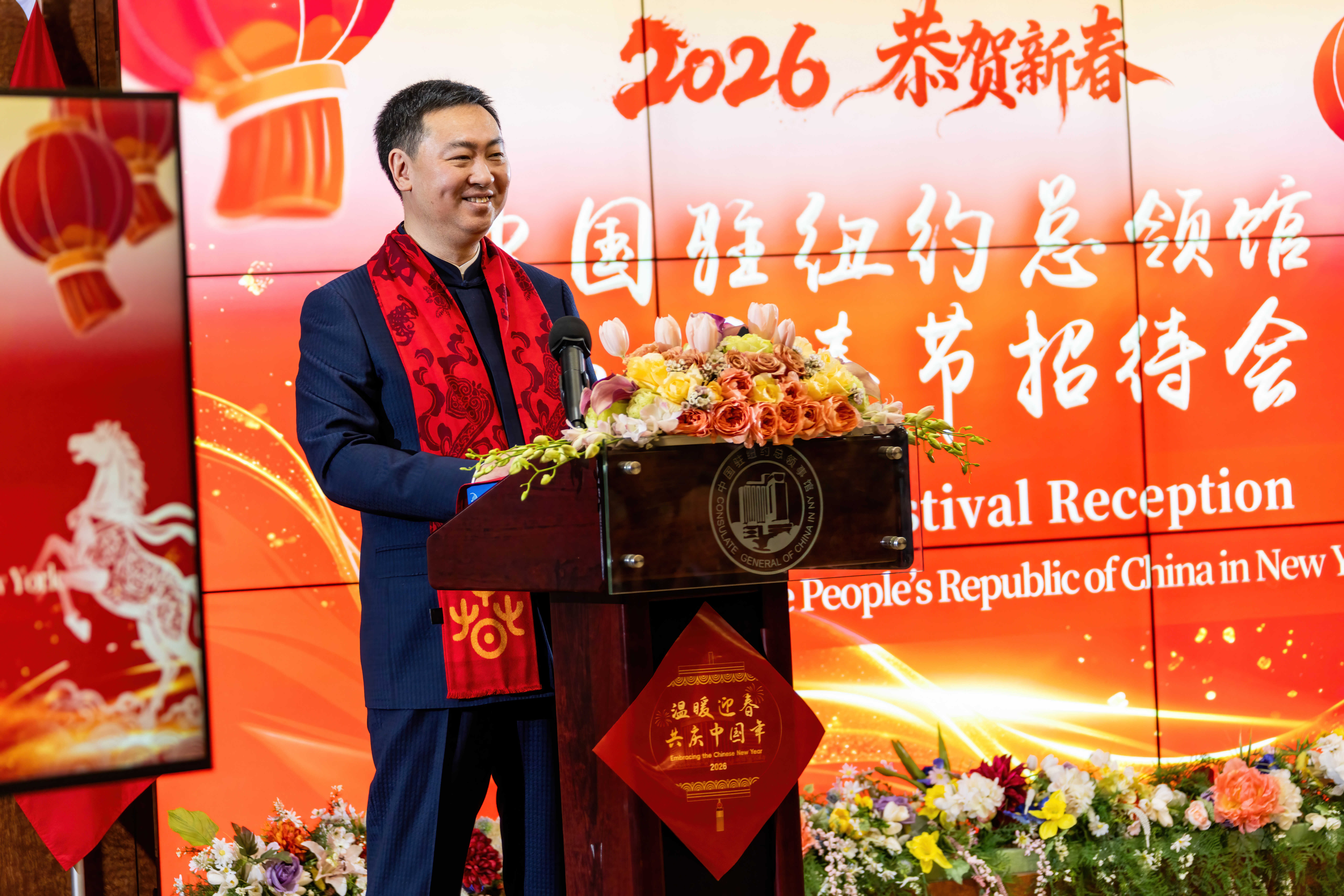
Ladies and gentlemen,
Dear friends,
Good evening. It’s a great pleasure to join you in celebrating the Year of the Horse.
In recent days, the hashtag “Becoming Chinese”, which means adopting Chinese lifestyle habits, has been trending on U.S. social media. That makes today’s gathering especially fitting. Welcome to the most Chinese time of the year.
As we turn the page to a new year, it’s natural to review what the past year has brought. Now, let’s watch a short video that captures the key moments.
(Video played)
The video we just watched answered two questions many of you have been asking lately: What were the major developments in China-U.S. relations? And what did the consulate do during that process?
People say that ups and downs are normal for a giant ship like China-U.S. relations. The past year has proven this point. The relationship moved from dark clouds on the horizon to turnarounds. This was made possible under the guidance of the two presidents through their five phone calls and the successful meeting in Busan. At critical moments, they took the helm and set the course for this ship.
Last year was my first full year here. What I saw and felt reminded me of a line by Mark Twain: “If you don’t read the newspaper, you are uninformed. If you do read it, you are misinformed.” On China-U.S. relations, in the papers, I mostly read about problems. But when I went out and looked for myself, I saw quite some ways forward. Many American friends gave me practical advice on how to communicate and build mutual understanding. One sentence stayed with me: “Storytelling is the best way to talk with the audience, not at them.” Following that advice, today I’d like to share a well-known Chinese story, and I’d also like to hear how you think about it.
One day on a riverbank, a clam was basking in the sun with its shell open. A sandpiper approached and began pecking at the clam’s flesh. The clam immediately closed its shell and clamped the sandpiper’s beak. The sandpiper said, “If you don’t let go, the sun will dry you out.” The clam said, “If you don’t pull out, you’ll perish from hunger.” As the two sides reached a deadlock, a fisherman happened to pass by and effortlessly took them both away.
The story is simple but relevant. Can China and the U.S. be partners, or must the two countries be adversaries? China’s answer is clear and consistent, that is China’s development can go hand in hand with the United States’ vision to make America great again. The two countries are fully able to help each other succeed and prosper together. China is ready to be a partner and friend of the United States.
I’ve put the same question to many Americans—officials and scholars, and everyday people too. They don’t always see U.S.-China relations the same way, but one thing keeps coming up. That is, much like in China, what people here care about most is everyday life. In the new year, everyone wants the same simple thing: a fresh start, steady progress, and life to feel more prosperous.
That is exactly the point: helping ordinary people live better lives—isn’t that the top priority for relations between countries? China-U.S. economic and trade cooperation has brought ordinary American households more affordable goods, more stable supply, and more choices. This is not about one side “making concessions” to the other. It is mutual benefit, through division of labor, higher efficiency, and win-win results.
For China and the US, turning their back on each other is not an option. It is unrealistic for one side to remodel the other. And conflict and confrontation has unbearable consequences for both sides.
If China is treated as an adversary across the board, the result is often not that one side wins over the other. It will be more like the story of the sandpiper and the clam, both lose the chance of mutual benefit and suffer more for nothing.
Win-win cooperation is not idealism. It is, rather, the rational conclusion we reach after seeing clearly the reality of China-U.S. relations. It is the best choice available.
Recently, the U.S. has been experiencing an extreme cold wave rarely seen in decades, the kind of cold that makes you question your life choices. But it’s precisely in this harsh cold that people long even more for warmth.
In the same way, after the difficulties and challenges of recent years, many people are hoping for a “warm spring” in China-U.S. relations. They hope that 2026 will be a year when two major countries advance toward mutual respect, peaceful coexistence, and win-win cooperation. We share that hope and want to see more warm currents of cooperation and fewer cold winds of confrontation.
In The Count of Monte Cristo, Alexander Dumas wrote that human wisdom can be summed up in two words: “wait” and “hope.” Rather than “waiting”, I find “perseverance” more fitting. We need to keep communication open and cooperation on track even against the wind. What we do in winter may not show results right away, but spring will have a way of revealing what becomes possible and making the answer clear.
I wish you all a happy Chinese New Year filled with warmth and strength. In Chinese culture, the horse stands for determination and forward momentum. So let’s keep moving forward, turn hope into action, and welcome a brighter spring together.
Thank you.
Consulate General of the People’s Republic of China in New York All Rights Reserved
http://newyork.china-consulate.gov.cn/