


From a Vermont story to a new chapter in China-U.S. relations
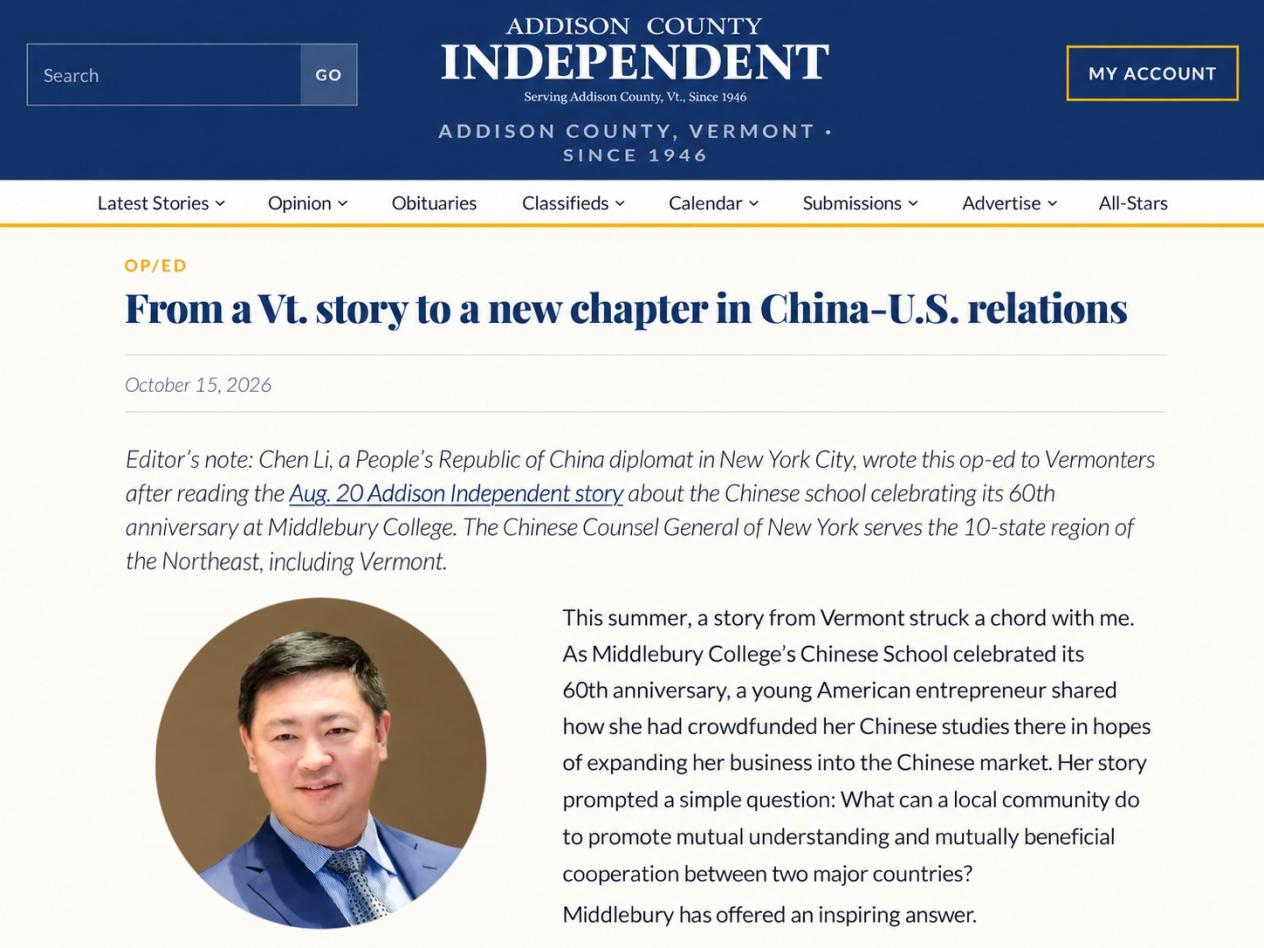
On Oct.15,2026, Addison County Independent published an article by Consul General Chen Li: “From a Vermont story to a new chapter in China-U.S. relations”. The full text is as follows:
This summer, a story from Vermont struck a chord with me. As Middlebury College’s Chinese School celebrated its 60th anniversary, a young American entrepreneur shared how she had crowdfunded her Chinese studies there in hopes of expanding her business into the Chinese market. Her story prompted a simple question: What can a local community do to promote mutual understanding and mutually beneficial cooperation between two major countries? Middlebury has offered an inspiring answer.
Looking back, the story of China-U.S. relations has always been written, in no small part, by the people of the two countries. More than 240 years ago, the steamship Empress of China sailed from New York to Guangzhou, opening direct trade between the two countries. More than eight decades ago, the American Flying Tigers fought alongside the Chinese people against fascist aggression during World War II. More than half a century ago, table tennis exchanges between our two countries helped break the ice and paved the way for the normalization of China-U.S. relations. And around a quarter-century ago, American teacher Ronald Sakolsky supported Chinese desertification-control pioneer Yin Yuzhen in her tree-planting efforts. Land once covered by shifting sands is now home to extensive woodland.
This September, President Xi Jinping paid another state visit to the United States after 11 years. He and President Trump agreed to build “a constructive China-U.S. relationship of strategic stability on the basis of respect, fairness, and reciprocity.” As Consul General, I have often asked myself how the important common understandings between the two presidents can be translated into opportunities, tangible results and positive expectations that people across the consular district can actually see and feel. With that in mind, three areas stand out to me.
First, we need to enable more young people to visit each other’s countries and learn from one another. During his visit, President Xi announced that China would invite 100,000 young Americans to China for exchanges and study over the next five years. The story of Middlebury’s Chinese School is a vivid example of the enduring vitality of people-to-people exchanges between China and the United States. I hope that in the years ahead, more young people from Vermont will cross the Pacific as China-U.S. relations move forward on a steady course, to learn the language, experience the culture, discover new opportunities and pursue their dreams in China.
Second, we need to help more mutually beneficial cooperation take root at the local level. The recent meeting between the two presidents produced eight deliverables and understandings. The two countries’ economic and trade teams reached a series of mutually beneficial arrangements, opening up brighter prospects for cooperation. China today has a dynamic consumer market. Winter sports continue to grow, distinctive agricultural products are finding their way onto more shelves and dining tables, and travelers are showing increasing enthusiasm for distinctive, experience-driven destinations. These are all areas in which Vermont has much to offer. The potential is already becoming visible. In 2025, Vermont’s agricultural exports to China rose by nearly 80 percent year-on-year. Leading Vermont snow-sports brands are actively expanding into the Chinese market. The possibilities for mutually beneficial cooperation are considerable.
Third, we need to bring together more voices in support of friendship and partnership. Not long ago, giant pandas Ping Ping and Fu Shuang arrived at Zoo Atlanta as ambassadors of China-U.S. friendship and received a warm welcome in the United States. American public attitudes toward China has continued to improve. In the first half of this year, the United States was also the leading source of visitors to China among countries outside China’s immediate neighborhood. Thanks to the efforts of people from all walks of life in both countries, the understanding that China and the United States can be friends and partners is becoming more tangible and gaining broader resonance. When Americans talk about China, the conversation need not be confined to news headlines. It can also be about a fascinating journey, a new friend or a cherished memory.
For China-U.S. relations to continue moving forward, we need both high-level engagement between our leaders and closer ties between our peoples. I look forward to visiting Vermont again, meeting friends from across the state, exploring new opportunities for cooperation and looking together toward the future. By doing so, we can all contribute to write the next chapter in China-U.S. relations.
Consulate General of the People’s Republic of China in New York All Rights Reserved
http://newyork.china-consulate.gov.cn/